Sign up for our newsletter
Join our scientific community to stay up to date with Element news, insights, and product updates.
This site is protected by reCAPTCHA and the Google Privacy Policy and Terms of Service apply.
At our recent Beyond event, we shared our product roadmap updates across multiomics, spatial profiling, and high-throughput sequencing.
Our goal is straightforward, we’re expanding what you can measure, increasing throughput when you need it, and removing unnecessary complexity from the lab. Our CEO, Molly He, put it best when she said that we’re building “technology that gets out of the way so science can move forward.”
Missed the event? Watch it on demand.
Here’s what we announced and what it means in practice.
Expanding into clinical sequencing: AVITI Dx™
We shared our plans to make AVITI Dx commercially available in 2026, with an initial regulatory filing in the European Union to obtain CE IVD marking as a Class A medical device.
AVITI Dx is built on the same chemistry used in our AVITI™ family of platforms. The system will support both locked down workflows and an assay design mode, giving clinical labs the option to run validated workflows while maintaining flexibility where needed.
We’ve been investing in manufacturing quality systems and infrastructure to support applications like newborn screening, oncology testing, and rare disease diagnostics, where consistency and reliability are essential and long-term commitment matters.
Multiomics on AVITI24™ with Direct In Sample Sequencing (DISS)
AVITI24 is designed for both sequencing and integrated multiomics experiments. With Teton™ and Teton Atlas™, researchers can measure RNA, protein, phosphoprotein, and morphology in the same cells, in a single workflow, directly from biological samples without library prep.
Instead of extracting nucleic acids and constructing sequencing libraries, DISS performs sequencing directly inside the sample. Because sequencing happens in situ, spatial context is preserved. And because it produces real sequencing reads, applications such as CRISPR guide sequencing and 3’ whole transcriptome profiling become possible in the same experiment.
We shared real-world stories using DISS to expand and accelerate discovery. Ashley Schwartz, a computational biologist at Element, shared how we examined EGFR inhibitor response in lung cancer cells and John Fullard, Center for Disease Neurogenomics, Icahn School of Medicine at Mount Sinai, shared pilot studies using 3’ whole transcriptome DISS for drug screening and CRISPRa studies.
These studies demonstrated that targeted and transcriptomic assays can work together to define high confidence states and expand discovery.
Bringing DISS into Tissue
.png?width=562&height=237&name=Tissue_A241%201%20(1).png)
Not only did we share how DISS is transforming discovery in cells, but we previewed spatial profiling in FFPE and fresh frozen tissue, to launch on AVITI24 in 2026.
Today, tissue profiling typically involves separate assays that are often analyzed independently. Our approach is to preserve spatial context to directly linking expressed variant detection to cell state and tissue architecture.
In early studies in colon cancer tissue, we demonstrated direct sequencing of transcript regions harboring oncogenic variants. Because DISS sequences longer stretches of cDNA, unexpected pathogenic mutations outside predefined hotspots can be detected.
We're excited to add this transformative capability to AVITI24 in H2 2026.
Introducing VITARI™
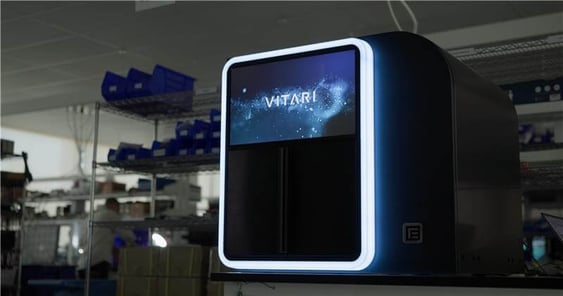
Beyond culminated in the reveal of VITARI, our new desktop high-throughput sequencing platform.
At full capacity, VITARI delivers up to 10 billion reads per run in a 2×150 configuration. One of the key features of VITARI is the flexibility of the design, output is split across two independent flow cells. Each flow cell includes six fluidically independent lanes, allowing flexible allocation of capacity across projects and without needing to wait to batch.
Quality is critical and VITARI maintains the same quality specification as our existing platforms, with 90% of bases greater than Q30. We designed VITARI to increase throughput without requiring additional infrastructure. It fits in a benchtop footprint and sequencing reagent cartridges ship under ambient conditions, reducing packaging and frozen shipping requirements.
VITARI will begin shipping in the second half of 2026, and preorders are now open.
Innovation built for real research
The updates we shared at Beyond introduce both new capabilities and, in the case of VITARI, a new platform.
What unites these innovations is a shared commitment to advancing science in ways that are both technically ambitious and grounded in real-world research demands. Each is purpose built to support different scales, workflows, and lab profiles. Rather than reinventing the technology for every new application, we continue to evolve AVITI24 to become more powerful, including the ability to profile tissue directly.
Together, AVITI24 and VITARI broaden what’s possible and extend the reach of discovery.
As research scales, in throughput, dimensionality, and impact, we’re focused on building systems that solve practical problems in the lab. We’re looking forward to continuing that work alongside the scientists pushing discovery forward!