Avidite Base Chemistry™ (ABC™)
Breakthrough sequencing technology that resets expectations for cost, quality, and flexibility

A fundamentally better sequencing chemistry
PCR-free amplification. Multivalent base detection. Low-bind surface chemistry.
Avidite Base Chemistry (ABC) is the sequencing technology behind every Element Biosciences instrument. Where standard sequencing-by-synthesis (SBS) combines base detection and strand extension into a single, error-prone step, ABC separates them, optimizing each step independently, across surface chemistry, biochemistry, engineering, and data analysis.
The result is consistently higher accuracy, lower reagent consumption, and a chemistry architecture built to keep advancing.
How ABC chemistry works

|
1. Template capture and rolling circle amplificationLinear libraries are circularized on the flow cell or circular DNA templates are loaded directly. Circularized libraries attaching to surface primers coating the flow cell and rolling circle amplification (RCA) copies each template into a dense polony, thousands of copies of the original molecule in close proximity. Because RCA replicates directly from the original template rather than amplifying copies of copies, PCR-induced errors and repeat slippage are avoided. RCA also eliminates optical duplicates and amplification-induced index hopping artifacts.
|

|
2. Avidite bindingAn engineered polymerase presents an Avidite™ dye-labeled polymer with multiple arms, that binds across multiple copies within the polony simultaneously, without incorporation or extension. Requiring multiple concurrent binding events to maintain position creates high-stringency detection with minimal background noise. Each Avidite represents a different nucleotide so there are no dark or unlabeled bases, eliminating a known miscall source in two-channel SBS chemistries. Unbound Avidites are washed away before imaging.
|

|
3. Stable signal detectionA low-binding surface chemistry captures template DNA on the flow cell and enables crisp, bright signal across all four detection channels. Working in tandem, an optical system with an extra-wide field of view maximizes the contrast-to-noise ratio (CNR). Together, these systems enable high signal-to-noise Avidite detection across the full flow cell surface and up to 100x reagent dilution without sacrificing accuracy, directly reducing the cost of sequencing.
|

|
4. Extension, unblock, repeatAvidites are removed and an engineered polymerase incorporates an unlabeled, reversibly blocked nucleotide to step the hybridized primer forward by one base. Critically, by forgoing fluorescently modified nucleotides entirely, ABC generates scarless, natural DNA. The blocking group is converted to a 3’ hydroxyl, and the next cycle begins. Incomplete dye cleavage is a compounding source of phasing errors and because ABC never uses fluorescent terminators, residual signal background is not a factor. This also means ABC maintains high incorporation efficiency and low phasing noise across successive cycles, improving data quality toward the end of long reads. |
How ABC compares to standard SBS
|
|
ABC chemistry |
Standard SBS |
|
Template prep |
Rolling circle amplification; no PCR, no error propagation |
Bridge PCR; errors introduced during amplification can propagate through the cluster |
|
Fragment size |
Supports fragments up to 1 kb+ |
Typically limited to ~500 bp |
|
Base detection |
Multiple Avidite binding events per base call; no dark or unlabeled bases |
Single-event detection; unlabeled Gs can produce miscalls, especially late in reads |
|
Extension |
Unlabeled terminator; no dye cleavage, no fluorescence carryover |
Fluorescent dye cleavage required; incomplete removal compounds phasing errors over cycles |
|
Homopolymer accuracy |
Maintained accuracy after homopolymers ≥12 bp |
Up to 5x error rate increase following long homopolymers |
|
Reagent cost |
Up to 100x dilution enabled by high signal-to-noise detection |
Higher reagent concentrations required |
ABC performance
Q40+ accuracy across the full read
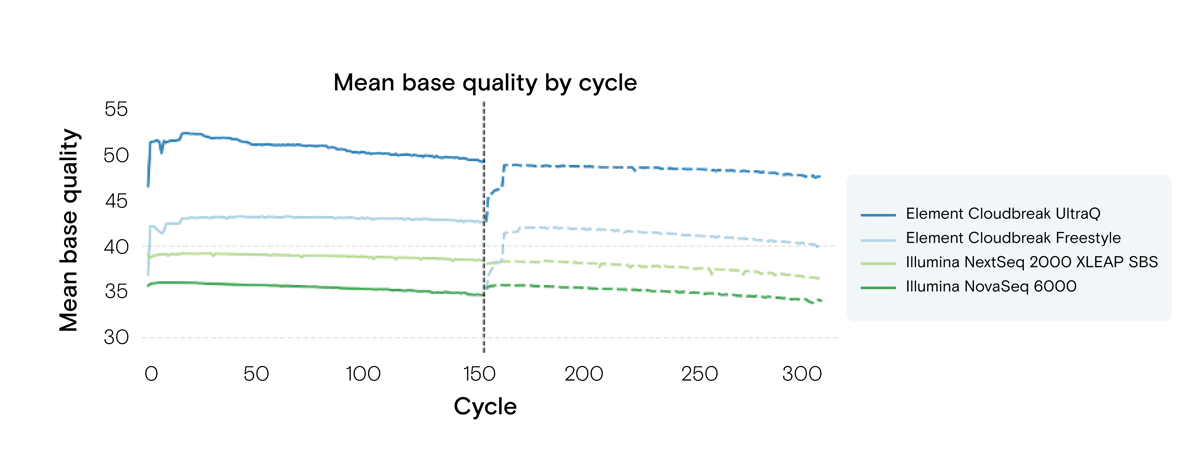
Mean base quality scores from 2×150 bp whole genome sequencing show ABC chemistry sustaining average base qualities near Q40 across both reads, approximately 1 error per 10,000 bases1. High accuracy holds even at homopolymers and other repetitive regions where conventional SBS chemistries struggle, with ABC chemistry maintaining consistently high base quality scores across the full read length 2-7.
Cloudbreak UltraQ™ sustains mean base quality above Q50 across all 300+ sequencing cycles, with more than 70% of data exceeding Q50 (99.999% accuracy per base). This is achieved by targeting errors at every stage: optimized chemistry, reducing library prep artifacts from deamination and end-repair, and refining alignment-based basecalling8.
Homopolymer and repeat accuracy
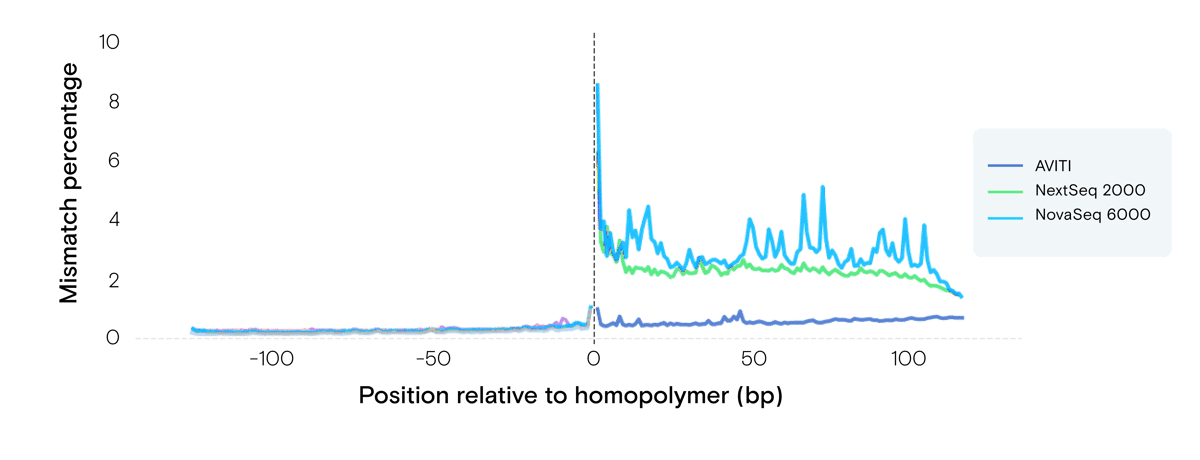
ABC maintains high read quality after homopolymers of 12 bp or greater, a region where SBS accuracy degrades sharply. This has direct implications for tandem repeat analysis, short tandem repeat (STR) studies, and somatic variant detection1,2,5,6.
Lower cost per run
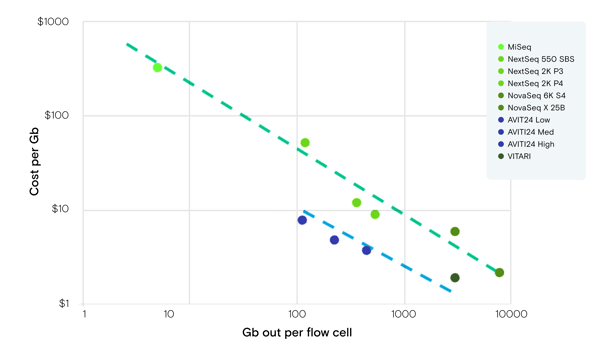
High signal-to-noise avidite detection enables up to 100x reagent dilution, reducing consumption per run without compromising data quality. On AVITI24™, advanced base calling algorithms deliver up to 50% more pass-filter reads compared to AVITI™, at the same run cost and with the same consumables.
References
- Arslan, S et al. Nat Biotechnol 42, 132–138 (2024). https://doi.org/10.1038/s41587-023-01750-7
- Chamberlin JT et al. NAR Genomics and Bioinformatics 6 (4) (2024). https://doi.org/10.1093/nargab/lqae175
- Porubsky, D et al. Nature 643, 427–436 (2025). https://doi.org/10.1038/s41586-025-08922-2
- Sehgal, A et al. Bioinformatics 40(8) (2024). https://doi.org/10.1093/bioinformatics/btae485
- Happ, HC et al. bioRxiv (2025). https://doi.org/10.1101/2025.09.25.678675
- Cheng, PC et al. bioRxiv (2026). https://doi.org/10.64898/2026.03.10.709901
- Sasani, TA et al. bioRxiv (2026). https://doi.org/10.64898/2026.03.06.710071
- Kruglyak et al. (2024). bioRxiv. doi:10.1101/2024.02.01.578321
A chemistry built to keep advancing
ABC isn’t just a better sequencing chemistry; it’s a structural foundation for innovation. That flexibility is what makes ABC an extensible platform rather than a fixed sequencing specification.
Direct In Sample Sequencing (DISS) is a proof point of that extensibility. By building on the ABC Avidite-based detection framework, DISS enables RNA sequencing readouts directly in intact cells, without extracting nucleic acids first. The same chemistry that drives high-accuracy next-generation sequencing becomes the foundation for spatial and cellular applications that would be impossible on a conventional SBS platform.
That is the nature of ABC: a chemistry solid enough to anchor continued performance improvements, and flexible enough to support entirely new biological readouts.
Frequently asked questions
What is Avidite Base Chemistry?
Avidite Base Chemistry (ABC) is proprietary NGS chemistry from Element Biosciences. It combines PCR-free rolling circle amplification, multivalent avidite-based base detection, low-binding surface chemistry, and unlabeled reversible terminators to deliver industry-leading accuracy and lower reagent costs.
How does ABC differ from SBS sequencing?
The core differences are in template preparation, base detection, and strand extension. ABC uses rolling circle amplification instead of bridge PCR, avoiding PCR-induced errors and supporting longer fragments. Base detection uses avidites, multivalent molecules requiring multiple simultaneous binding events, rather than single fluorescent terminators. Extension uses an unlabeled blocker, eliminating fluorescent dye cleavage and the phasing errors it can cause. ABC also generates scarless, natural DNA while SBS chemistries leave molecular remnants from dye cleavage that accumulate over cycles.
What accuracy does ABC chemistry deliver?
ABC routinely achieves Q40 accuracy (1 error per 10,000 bases) in standard WGS runs. With Cloudbreak UltraQ, mean base quality exceeds Q50, with more than 70% of data above Q50 (99.999% accuracy per base).
How does ABC handle homopolymers?
ABC maintains read quality in homopolymers, a region where standard SBS error rates increase. This makes it well-suited for tandem repeat, STR, and somatic mosaic variant analysis.
What applications does ABC chemistry support?
ABC supports whole genome sequencing, whole exome sequencing, RNA-seq (including scRNA-seq), targeted sequencing, long-insert sequencing, amplicon sequencing, and somatic variant detection at sub-1% VAF. UMI support, single- and dual-indexing, and paired-end runs are all compatible.
What library types are compatible?
ABC is compatible with most standard short-insert libraries, long-insert libraries (up to 1 kb+), and UMI-tagged libraries. Linear libraries can be loaded for automatic on-board circularization without the need to modify or replace adaptors using Cloudbreak Freestyle™ kits.
Resources
For Research Use Only. Not for use in diagnostic procedures.