Scale your genotyping without scaling your costs
Genotyping-by-sequencing (GBS) uses next-generation sequencing to assess genetic variation across large populations without the fixed marker constraints of arrays. Whether you're running genomic selection in a breeding program, mapping trait associations across a diverse population, or building a genotyping service for agrigenomics customers, GBS on the AVITI™ family of systems is designed to provide the accuracy, throughput, and cost-efficiency to make it work at scale.
How researchers use GBS
 |
Breeding and genomic selectionGenotype thousands of animals with scalable, cost-effective panel or low-pass based solutions that are ideal for cattle, poultry, and aquaculture breeding programs. |
 |
Population genomicsCapture genome-wide variation across diverse cohorts for GWAS studies using panel or low-pass WGS. |
 |
Core facilitiesUse efficient and cost-effective target capture or low pass sequencing to offer agrigenomics customers GBS in addition to a full array of genomics applications on a single platform. |
What to look for in a GBS workflow
Not all genotyping approaches are equal. When evaluating your options, a few factors matter most:
- Cost per sample at scale: Arrays have historically set the cost benchmark for large-cohort genotyping. A sequencing-based approach needs to be genuinely competitive on the full per-sample cost.
- Marker flexibility: Fixed probe sets can't capture novel variants or adapt to populations that diverge from the reference used in panel design. An approach that isn't constrained to predefined markers gives you more complete and transferable data.
- Accuracy: For low-pass WGS, the quality of downstream genotype calls depends on sequencing data quality. High Q30 rates and low duplication reduce noise that's otherwise difficult to distinguish from true rare variants at low coverage.
- Workflow scalability: High-throughput genotyping means hundreds to thousands of samples per run. Throughput, library pooling limits, and hands-on time per sample all affect whether a workflow is sustainable at the scale your program actually requires.
- Bioinformatics integration: Established pipelines from library to genotype call remove a significant bottleneck. Look for established partnerships with imputation and analysis platforms your team already trusts.
GBS on the AVITI™ family of systems
Genotyping by sequencing encompasses several different techniques, each with its own advantages. Element Biosciences has end-to-end workflows for whatever option best suits your needs, including Trinity™ target capture, low pass whole genome sequencing, or target capture with tunable low pass coverage.
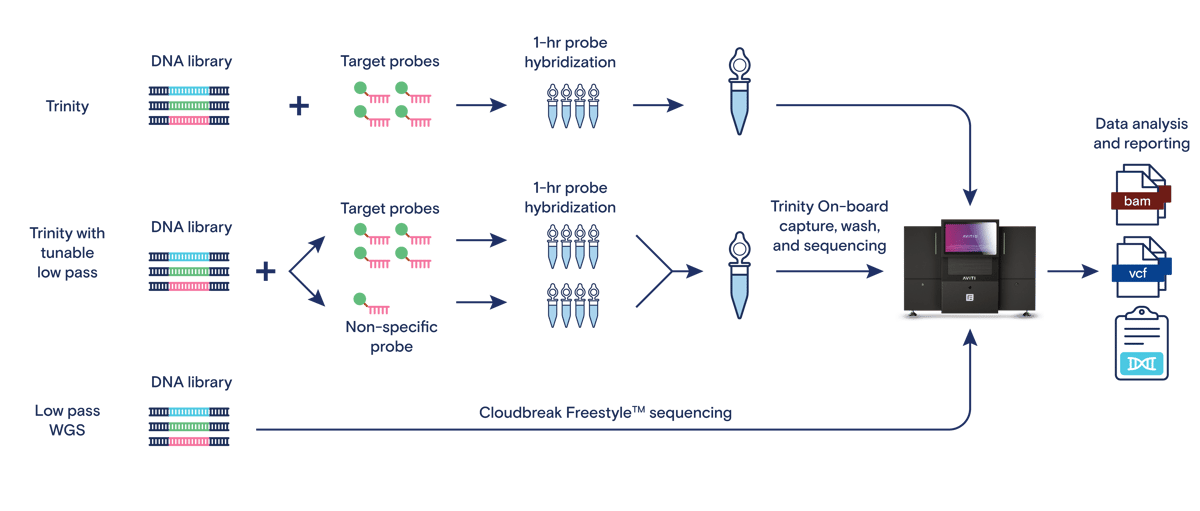
Whether you need focused target capture, genome-wide low-pass coverage, or a combination of both, we’ve partnered with industry leaders to support compatibility at every step.
|
|
Target capture |
Low pass WGS |
Panel plus genotyping |
|
Library Prep |
Twist FlexPrep for auto-normalization and early pooling or other third party NGS library prep solution of your choice.
|
Twist FlexPrep for auto-normalization and early pooling of highly multiplexed libraries. |
Twist FlexPrep or other third party NGS library prep solution of your choice.
|
|
Sequencing |
On-flow cell target capture and 2x150 Trinity or Trinity Freestyle™ sequencing of up to 768 multiplexed samples on AVITI or AVITI24. |
2x150 Cloudbreak Freestyle sequencing of up to 768 multiplexed samples for accurate imputation with as low as 0.1x coverage. |
Pool hybridization reactions to achieve tunable low pass coverage at your depth of choice.
|
|
Analysis |
Curio Genomics or other mapping, variant calling, and reporting software of your choice. |
Gencove, Khufu or Curio Genomics for mapping, imputation, variant calling, and reporting. |
Curio Genomics, Khufu, or other imputation and reporting software of your choice. |

Resources