Protein Overview
CD19 is a B-lineage-restricted co-receptor that forms a signaling complex with CD21, CD81, and CD225, amplifying BCR signaling. Upon BCR engagement its cytoplasmic tail is phosphorylated, recruiting PI3K, Vav, PLCγ, and Lyn, lowering the antigen threshold for B cell activation and shaping B cell fate decisions.
Expected Localization
Plasma membrane, single-pass transmembrane glycoprotein with two extracellular Ig-like domains and a large signaling-competent cytoplasmic tail.
Expected pattern is membranous/surface labeling of individual B cells.
Expected Expression Pattern
Expressed on B lymphocytes across nearly all developmental stages (pro-B through most plasmablast stages) and at low levels on follicular dendritic cells; found in blood, tonsil, lymph node, spleen, and bone marrow. Retained on most B-cell malignancies, though can be downregulated after CD19-directed immunotherapy.
Relevant Pathways
- BCR co-receptor signaling amplification
- CD19/CD21/CD81/CD225 complex formation
- PI3K, Vav, and PLCγ recruitment and activation
- B cell receptor microcluster formation and immune synapse assembly
- B cell development and differentiation
Clone Information
Antibody Species: Rabbit
Cell Type Compatibility: Validated in human cells only using Cytos™ kits.
For more details on the clone and reactivity with other species, visit ABclonal and search for the clone catalog # A19013BCS.
Qualitative Results
Localization Assessment
CD19 protein panel demonstrates strong localization to the CD19+ B cell membrane. The observed localization of CD19 protein is consistent with published data.
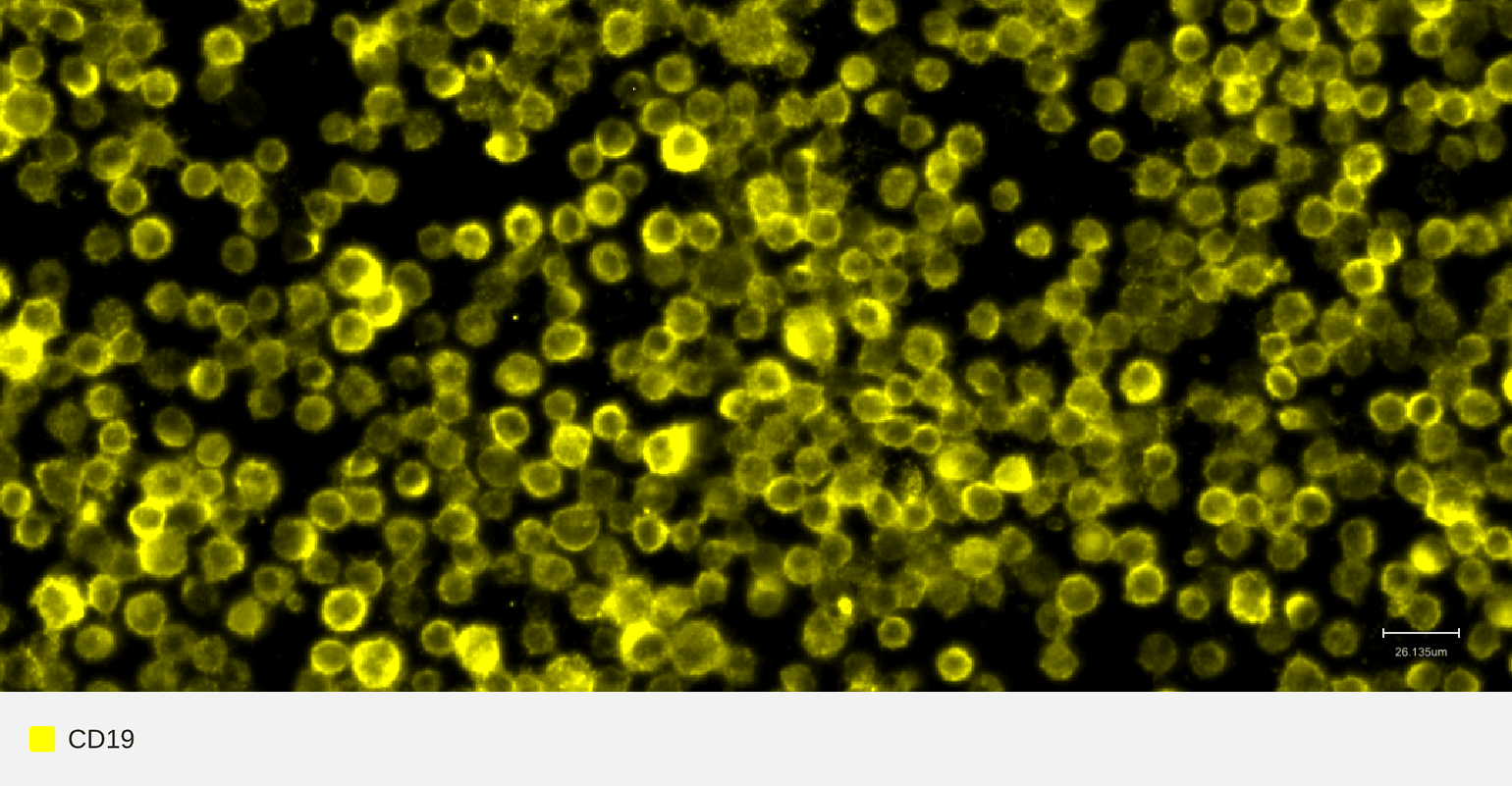
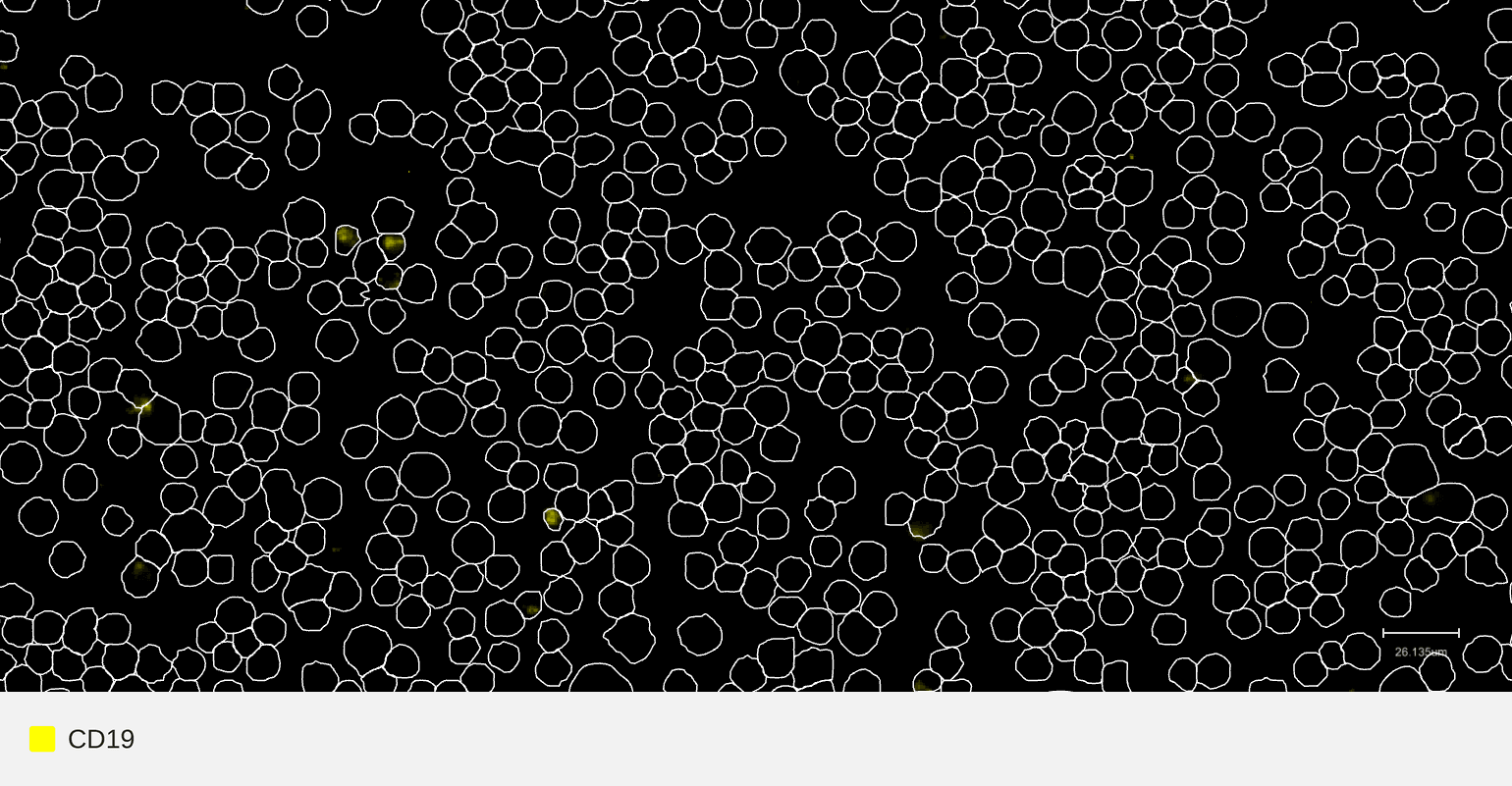
| Raji | Jurkat |
Jurkat and Raji cells were cultured independently in flasks, spun down to a 12-well format following the user guide for suspension cells, fixed with 4% formaldehyde for 30 minutes, and permeabilized using 70% ethanol for 10 minutes. Cells were then incubated with probe made with biotinylated Rabbit monoclonal anti-CD19 antibody for 1 hour at room temperature. The slide kit was then assembled into a flow cell and loaded onto an AVITI24™ along with the Cytos Protein Cartridge for a multiomics cell screening run. CD19 demonstrated expected expression in Raji and no obvious expression in Jurkat cells. These results support high confidence in target-specific detection and validate this antibody as a passing clone.
Quantitative Results
| Signal-to-noise ratio Acceptance criteria: > 2x background |
Pass |
- 6.51 ± 1.4 (Raji; n=2 runs)
Indicates the fold brightness of the target signal as measured by the Mean Intensity Above (Otsu-defined) Threshold (IAT), over the background (a channel-matched isotype control) in the same cell. The ratio of 13.41 in the CD19-positive Raji line is well above the acceptance threshold demonstrating specific, easily distinguishable detection.
|
Panel-level run-to-run reproducibility |
Pass |
For each imaging panel, we assess reproducibility by comparing the intensity signal a given antibody target produces across independent replicate runs. Within each run, we measure the average per-well fluorescence intensity for every target in the panel. We then plot each target's intensity from one run against the matching target's intensity from another run of the same layout, and calculate the Pearson correlation coefficient (r) between those two sets of measurements. Squaring that value gives the R² (coefficient of determination), which reports what fraction of the variation in one run's signal is explained by the other run's signal.
Disclaimer: This information is provided to help assess whether the target suits your experiment. It reflects internal testing conditions and does not guarantee performance in your application. Performance in other cell types and species such as mouse or rat may require additional validation using Cytos kits as performance is not guaranteed.
ELEMENT BIOSCIENCES For Research Use Only. Not for Use in diagnostic procedures.