Question:
How do I adjust loading for sequencing a custom panel with Trinity or Trinity Freestyle on the AVITI™ or AVITI24™ system?
Answer:
Element recommends contacting your Field Applications Scientist or Support for starting input recommendations before setting up your first Trinity or Trinity Freestyle sequencing run with a custom panel.
You can use the panel and genome size to approximate the theoretical loading amount for your custom panel. Other variables can impact hybridization and capture efficiency, so you can adjust loading as needed to optimize for your panel. Using the hybridization conditions provided in the Trinity exome sequencing protocols as-is with a custom panel is not recommended and can result in lower output than expected.
Summary
- The hybridization input and amount loaded onto the instrument for custom DNA probe panels can differ from the conditions for the validated Twist and IDT exome panels
- Approximate a loading starting point for your custom panel using the panel and genome size (capture space)
- Custom panels require some loading optimization due to differences in panel design, probe type, and other variables
Contact your Field Applications Scientist or Support for recommendations when planning Trinity or Trinity Freestyle sequencing runs with a custom panel.
Considerations
Custom panels are enabled with Trinity and Trinity Freestyle sequencing kits, but require adjustments to hybridization conditions to maximize performance.
Unlike traditional in-solution workflows, Trinity eliminates post-capture amplification. As a result, the molecules captured during Trinity hybridization are directly represented in the sequencing output. Without the post-hybridization PCR that normalizes your number of capture molecules in a standard hybrid capture workflow, the Trinity workflow requires you to input sufficient targetable library molecules to reach the desired flow cell output. As a result, custom panels require loading and hybridization conditions that differ from those provided in the validated workflows for the Twist Bioscience and IDT exome panels.
Variables that Influence Loading
Some custom panels require loading optimization to achieve the target sequencing output as many variables impact the capture efficiency for a given panel. Variables that impact hybridization input and amount loaded onto the instrument include:
- Panel size and genome size (capture space)
- Panel design
- Target regions
- Panel GC content
- Probe type
- Probe concentration
- Library size
- Adapter quality
Understanding Capture Space
Capture space is defined as the ratio of the panel size (number of bases covered by the panel without overlap) to the species' genome size.
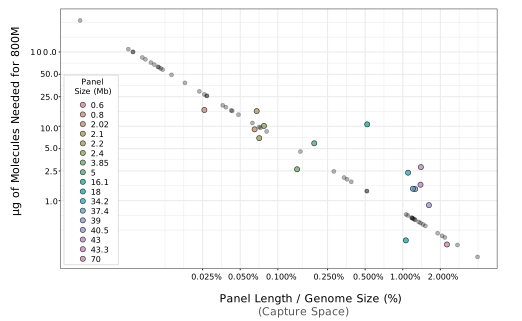
Figure 1. Representation of instrument loading by capture space (ratio of panel length to genome size). Grey circles represent theoretical panels and colored circles represent tested panels.
Figure 1 shows the approximate total instrument loading amount calculated for a range of theoretical (grey circles) and tested (colored circles) hybrid capture panels. One of the most significant factors affecting capture performance with Trinity is the capture space.
The capture space is represented on the x-axis in Figure 1. The total (not per-sample) DNA input into the hybridization reaction to achieve the target flow cell output is represented on the y-axis. When the genome size is held constant, as panel size increases, the capture space decreases, and the total DNA required to achieve the target output increases.
The theoretical values (grey circles) in Figure 1 can provide a helpful starting point for loading based on capture space. The values for the tested panels (colored circles) show that the experimental loading amount required to achieve the target sequencing output sometimes differs from the theoretical value. This is due to the impact of other variables beyond capture space that also influence capture efficiency.
To learn more about sequencing various panel sizes with Trinity kits, see our pre-print publication.
Estimate Loading by Proxy to Exome
You can use a comparison of your custom panel with one of the validated exome panels to estimate a starting total loading concentration for your first Trinity or Trinity Freestyle sequencing run. The more your custom panel differs from the exome reference panel in its design, the more the loading and hybridization conditions will differ from the exome protocol. However, this calculation method can still provide a helpful starting point from which to optimize loading for your custom panel. Review the following examples for help:
Example 1: Same Genome (human) but Different Panel Size
In this example, a custom panel has a size of about 3.3 Mb and targets regions in the human genome. This panel shares the same target genome as the 37.4 Mb Twist for Element exome panel, which already has a validated Trinity workflow. The custom panel is ~11.3 times smaller than the Twist exome panel, so loading ~11.3x more for the custom panel is a good starting point. If the Trinity Twist exome workflow recommends loading ~1 µg total on the instrument, load 11-12 µg total as a starting point for this panel.
Example 2: Different Genome and Different Panel Size
In this example, a custom panel has a size of ~5 Mb, and targets regions in a non-human genome that is ~2.6 Gb in size. To use the same reference panel as in example 1, you need to take both the different panel size and the different genome size into account to calculate a starting point for loading.
To adjust for the genome size, find the ratio of the human genome size (~3.1 Gb) to the size of the genome-of-interest (~2.6 Gb). To adjust for the panel size, multiply this ratio by the custom panel size. The adjusted target (~5.96 Mb) is ~6.3 times smaller than the Twist exome panel (~37.4 Mb). The recommendation is to load ~6.3x more for this custom panel as a starting point. If the Trinity Twist exome workflow recommends loading ~1 µg on the instrument, load 6-7 µg total as a starting point for this panel.
Estimate Loading by Capture Space
You can also estimate a starting loading concentration for your custom panel using capture space. Start by calculating the capture space of your panel, then use the graph in Figure 1 to approximate the loading amount for ~800M reads on AVITI. Review the following example for help:
Example: Pan-Cancer Panel
In this example, a pan-cancer panel has a size of ~800 kb and targets regions in the human genome. You can calculate the capture space for this panel using the following formula:
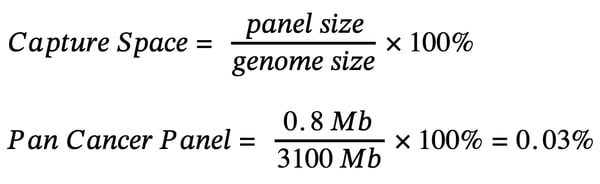
Based on the calculated capture space of ~0.03%, the estimated loading based on the theoretical values (grey circles) in Figure 1 is ~24 µg total.
For more details on the sequencing protocol and the final results, see the Trinity Workflow for IDT xGen Pan-Cancer Panel Application Note.
Other Considerations
End-Polishing Small Panels
For custom panels less than 2.5 Mb in length, we recommend end-polishing your Trinity libraries with a few cycles of PCR before pooling and hybridization. While end-polishing is recommended, small panels can still be sequenced with Trinity without end-polishing provided there is enough input to meet the panel’s loading requirements. Libraries without end-polishing require more input material than libraries that have been end-polished.
Fractional Loading for Large Panels
Some larger panel protocols (e.g. Twist for Trinity Freestyle exome) require a fraction of the hybridization reaction to be added to the sequencing solution to avoid overloading the Trinity flow cell. The remainder of the reaction can be stored and used for future sequencing runs (see associated protocol for storage conditions). Contact your Field Applications Scientist or Support if you are unsure whether you should use fractional loading of your custom panel hybridization reaction.
Pool Plexity
Pool plexity can be adjusted to meet total loading requirements. For more information, see How do I determine plexity and pool hybridization reactions for sequencing with Trinity or Trinity Freestyle?
RNA Probes
Trinity does not currently support RNA probes. However, we recommend contacting your Field Applications Scientist or Support to learn about other available options.