Background
This study demonstrates a multimodal compound screening workflow with Cytos on AVITI24™, using tunicamycin as a model compound. Tunicamycin induces the unfolded protein response (UPR), giving a well-characterized, multimodal readout for validating that the platform captures real, coordinated compound-induced biology—directly relevant to compound-response profiling in drug discovery.
Experimental Design & Methods
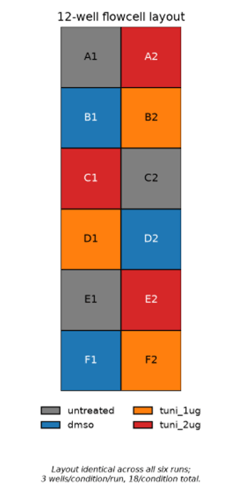
HeLa cells were cultured in a Cytos flow cell and either left untreated or treated with DMSO vehicle, 1 µg/mL tunicamycin, or 2 µg/mL tunicamycin then fixed. Cells were profiled on AVITI24 collecting cell paint, a protein panel, and 3’ whole transcriptome across six replicate runs, giving 18 wells per condition and ~750,000 cells total. Each run produced a spatial data object in which all three modalities were registered to the same cells: cell boundaries are segmented from the cell painting channels, protein intensities, and transcript counts computed following alignment, were assigned to those boundaries.
Data highlights
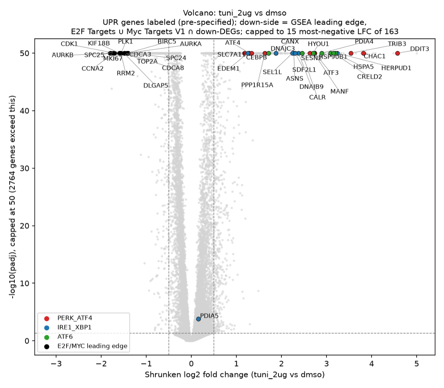 |
Tunicamycin drives a large, coherent transcriptional responseTreatment with tunicamycin resulted in differential expression of 2,381 genes at the higher dose, inducing all three UPR branches—PERK, IRE1, and ATF6. The response was near maximal at the lower dose, with just 188 genes additional differentially expressed genes at 2 µg/mL over 1 µg/mL. |
 |
Compound response is shared across the population, not confined to a subset of cells
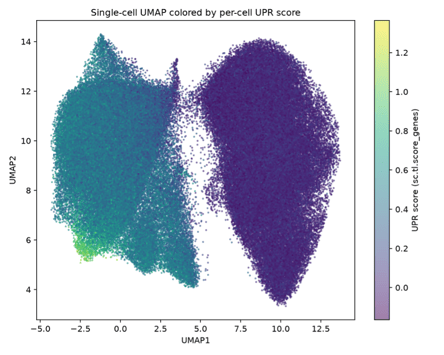
Single-cell UPR scores remain unimodal at both doses, with treated cells actually more homogeneous than controls, confirming this is a population-wide response rather than a strong effect in a small subset of cells, a distinction bulk measurement alone can't make. |
Download the full dataset
Explore data from a Cytos drug screen on AVITI24.