Sign up for our newsletter
Join our scientific community to stay up to date with Element news, insights, and product updates.
This site is protected by reCAPTCHA and the Google Privacy Policy and Terms of Service apply.
The National Genomics Infrastructure (NGI) at SciLifeLab stays at the forefront of new technology so when they evaluate a new platform, the bar is high. Supporting hundreds of research projects, NGI needs instruments that not only keep pace with scientific research but also open doors to new possibilities.
That’s exactly what drew Anja Mezger, PhD, Head of Unit, Genomic Applications and the NGI team to AVITI24 from Element Biosciences.
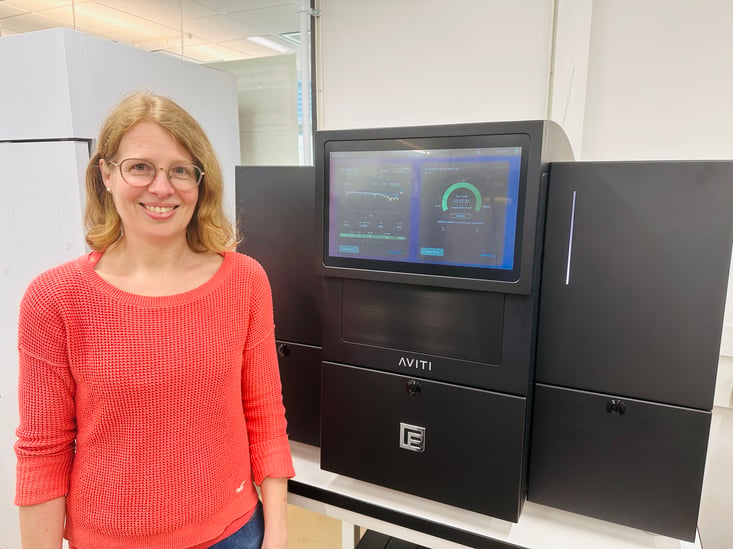
Staying at the forefront: Why NGI Chose the AVITI24
For Mezger, the decision to invest in the AVITI24 came down to more than sequencing performance. “At NGI, we’re always interested in staying at the forefront of technology and research,” she explains. “We like to invest in new technology and be one of the first ones.”
NGI already operates a robust portfolio of sequencing and spatial platforms and the AVITI24 filled some gaps, serving as a natural complement to their existing infrastructure.
With a strong track record in spatial transcriptomics, the prospect of Direct In Sample Sequencing made the AVITI24 particularly compelling. “It doesn’t just do NGS,” Mezger notes. “It also has all the other capabilities, the multiomic approach, and we have quite a strong track record in spatial transcriptomics, so that’s been very interesting to us.”
Sequencing data quality that exceeds expectations
NGI has now been running the AVITI24 for approximately two years, and Mezger is direct about the results: data quality has performed above expectations.
The team initially deployed the instrument for custom sequencing applications that didn’t fit their other platforms, particularly projects requiring long amplicons, where read quality typically degrades toward the end of a run. “With longer reads, we see that data quality basically stays pretty much the same,” Mezger says. “Especially in Read 1, the quality doesn’t degrade very much, with other instruments we can see that at the end of a 600 cycle run, the base quality is not as good anymore.”
That consistency matters more than it might seem. In applications like 16S amplicon sequencing, a sequencing error doesn’t just affect a data point, it can cause a read to map back to the wrong species. For NGI’s diverse user base, high base accuracy means research findings reflect biological truth, not sequencing artifact.
Beyond quality, the AVITI24 has proven straightforward to operate at scale. After the initial learning curve, the team has automated their data flow and finds the system easy to set up and run.
New science that wasn’t possible before
For NGI, high data quality and sequencing were the AVITI24 foundation, and its multiomic capabilities are what have Mezger and the team most excited about the road ahead. Mezger explained how the platform’s ability to simultaneously profile transcriptomics, proteomics, and cell morphology at scale, on the order of a million cells at different conditions, represents a meaningful leap.
That transcriptomics-plus-proteomics-plus-morphology combination is particularly novel. Mezger shared, “While targeted protein profiling has been achievable, the addition of the cell morphology readout is really unique to this approach.”
For researchers designing complex phenotypic screens or studying how cellular structure relates to gene expression, this opens new experimental territory.
Looking further ahead, Mezger is especially excited about two emerging application areas: optical pooled screens and tissue-based assays. “It’s very exciting,” Mezger explains. “Combining true single-cell resolution not probe-based but direct sequencing, means we can detect SNPs and so on.”
A partnership built for adoption
As one of the first European sites to adopt the AVITI24, NGI has seen the trajectory of Element Biosciences and benefited from close engagement with the team. For Mezger, that accessibility has been a meaningful part of the experience.
“It’s really nice working with Element,” she says. “It’s easy to have personal contact with both the people in the field, like our field application scientists, and sales, but also the executive leadership.”
For other core facility leaders considering the AVITI24, Mezger’s advice is practical: lean on the resources and support that Element provides and collaborate with your local team to identify the right projects. NGI ran a dedicated grant call to seed novel applications on the instrument, an approach Mezger recommends as an effective way to build a pipeline of compelling use cases.
Advancing genomics at scale
NGI’s experience with the AVITI24 reflects what happens when a platform’s capabilities align closely with the expansion of a core facility. From high-fidelity amplicon sequencing to simultaneous multiomics, the instrument is helping NGI support research that reaches further than before.
As Direct In Sample Sequencing and tissue-based capabilities continue to mature, Mezger and the team at NGI are well-positioned to be among the first to put them to work, continuing the tradition that led them to the AVITI24 in the first place.
Learn more about SciLifeLab.
Interested in learning how the AVITI24 can support your research or core facility? Contact us.